


A Musical Journey Rooted in Identity: Cultural Dialogue
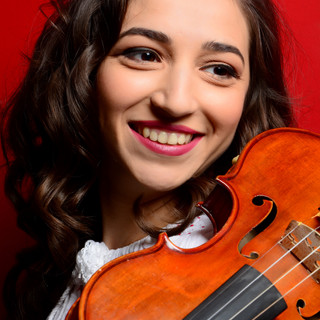
Dear friends,
I am delighted to share with you a recent interview I had the joy of giving on October 31st 2025, shortly after my lunchtime recital at the Hampstead Garden Suburb Free Church in London.
This conversation — originally conducted, written, and published in Romanian here by journalist Petru Clej for Radio France Internationale Romania — explores themes close to my heart: music, memory, identity, and the quiet threads that shape an artist’s path.
We spoke about the repertoire I chose for that day, the emotional resonance of Romanian and British music, the roots of my artistic journey, and the dreams that lie ahead — including my upcoming debut at Carnegie Hall.
I am honoured to present here my English translation of the interview, both in video format and as written text.
For those who prefer to listen, I have recorded the full interview in English. You can watch it below:
'It is very important to choose music that resonates with my history' – violinist Adriana Cristea
(English Translation by Adriana Cristea)
Petru Clej: Adriana Cristea, you have just finished performing a lunchtime recital at the Hampstead Garden Suburb Free Church in North-West London. The programme featured a truly remarkable repertoire with distinctive composers — including Jacques Offenbach, Paganini, Piazzolla, Elgar, Dvořák, de Sarasate, and of course, Ciprian Porumbescu, who simply had to be included. How did you choose this repertoire?
Adriana Cristea: The programme required a considerable amount of reflection and planning, as I always take into account both the audience and the timing of the concert. I am glad I found the opportunity to perform this recital for today, October 31st, during the autumn half-term break — which allowed children to be present in the audience, something that does not usually happen at lunchtime concerts, as they are typically in school at that time.
I aimed to combine expression and virtuosity with a repertoire that would be accessible to the public, while also bringing something new. The first piece, Barcarolle by Jacques Offenbach is a transcription of mine that I completed approximately four years ago. I had this piece in mind as the opening moment of the concert, as it creates a welcoming atmosphere quickly and naturally, helping me open myself emotionally so I can dive deeply into the music and connect with the audience.
The final two pieces — one by Jenő Hubay and the other by Pablo de Sarasate — are part of a future evening project I hope to realise. I have already begun transcribing the string orchestration for that programme. This made me shape today’s concert from multiple angles: the idea of a future evening project on one hand, the ‘past’ transcription of Offenbach’s Barcarolle on the other, and the recorded backing tracks I created for the other pieces.
Petru Clej: The concert was a soulful one, and you referred to both your native country — Romania — and your adoptive country — the United Kingdom. Inevitably, you performed the famous Ballad by Ciprian Porumbescu, as well as Elgar’s Salut d’Amour, as a homage to the country that has become your home.
Adriana Cristea: That is true. I also wanted to group these two pieces together in the concert programme — one after the other — as a musical tribute to both the country that has adopted me and the country that gave me life. Both are very dear to me, and I chose to combine them in this way. I felt it was important to select pieces of music that resonate with my personal history.
Petru Clej: And I do not think there is any other violin piece more representative than Ciprian Porumbescu’s Ballad. If you would like, perhaps you could share a bit more about him and his deep attachment to Romania.
Adriana Cristea: It has deeply impressed me. Ballad is a piece that I can hardly listen to without crying. Whenever possible, I aim to include at least one work from the Romanian classical music repertoire in my concerts.
Petru Clej: I can see that you have a project called Romania With Love, (embed the RWL link) which focuses on some lesser-known Romanian composers. If you would like, please share a few more details about it.
Adriana Cristea: It is my very first recital programme, with which I began this series of themed recitals in 2018. I define it to myself as my ‘childhood treasure.’ The pieces included in this programme were written by lesser-known Romanian composers.
Petru Clej: Could you give us a few examples?
Adriana Cristea: Beyond Romanian borders. A few examples: Ion Scărlătescu, Constantin Dimitrescu. I would even say Angheluș Dinicu — with his famous Skylark — although the piece is internationally recognised, there are not enough details, in my opinion, about who Angheluș Dinicu was — the grandfather of Grigoraș Dinicu —
Petru Clej: Who was a worldwide celebrity.
Adriana Cristea: Yes, and more details about his life path. There are many things that remain unsaid, which I have wanted to express through music. I am now thinking of some other lesser-known composers from the Romania With Love programme — Mircea Chiriac, the father of the famous Romanian singer Corina Chiriac.
Petru Clej: Now that we have spoken about Romania and Romanian music, please tell us a few words about your career and professional training.
Adriana Cristea: I started playing the violin at the age of five, just for fun, and began studying seriously at six. My first teacher was my mother. At six years old, I began taking violin lessons at the Arts High School in Ploiești — now known as Carmen Sylva Arts College — with the late teacher Adrian Ceapă, with whom I studied for seven years until 2004. I then transferred to Dinu Lipatti Music High School, currently known as Dinu Lipatti National College of Arts. During the final two and a half years of my high school studies, I transferred to George Enescu Music High School, where I studied with Professor Mihaela Tomescu, the mother of violinist Alexandru Tomescu.
Petru Clej: After that, you went on to study at the National University of Music.
Adriana Cristea: Yes, I completed my undergraduate studies with Maestro Florin Croitoru, an internationally renowned violinist and professor. It was a time marked by intense work and self-discovery — a period filled with questions, often more questions than answers. In my chamber music studies, I worked with Professor Verona Maier, who greatly inspired me and broadened my perspective not only on music, but also on life — particularly on what it means to be trustworthy, both to oneself and to others. Chamber music, after all, demands collegiality, cooperation, team spirit, attunement, and mutual understanding — sometimes even at the expense of one’s own interests, when the context calls for it. It is a very fine line.
Petru Clej: How did you come to settle in the United Kingdom?
Adriana Cristea: It was a pivotal moment for me — the end of 2012, when I applied for my Master’s degree.
Petru Clej: You were still a student at that time.
Adriana Cristea: I was in my fourth year when I sent a video recording to the Royal Northern College of Music in Manchester. I received the news of my acceptance — with a scholarship — while I was on a concert tour in China, just before Christmas. I remember clearly that I did not tell anyone for two weeks. The joy I felt was so intense, it was almost unbelievable. I wanted to hold onto it quietly before sharing the news. It was truly an exceptional moment.
Petru Clej: You have performed in some renowned concert halls. What is the most memorable experience you have had?
Adriana Cristea: That is a difficult question. There have been several moments like this. Perhaps the first one that comes to mind is my performance at the Royal Concertgebouw in Amsterdam in 2019. I received the news that I had been selected to perform there following the results of an international competition in which I had participated. And, I felt the same intense joy then as I had felt after my acceptance to the Royal Northern College of Music back in 2012. From this perspective, I would say that this may be one of the happiest experiences I have had.
Petru Clej: In short, who are the composers you favour most?
Adriana Cristea: That is a difficult question, because there are many. If I had to sum up the history of violin music in one composer, that would be George Enescu.
Petru Clej: Among your maestros, whom would you be most inclined to mention?
Adriana Cristea: I would mention my late Maestro Alecu Leseanu. It is difficult for me to think about him without crying. He was not only a maestro — he was an angel.
Petru Clej: Among the great violinists worldwide, whom do you admire the most?
Adriana Cristea: I admire many violinists. I have great admiration for Alexandru Tomescu, and I also admire Clara-Jumi Kang, whom I listen to frequently. I greatly admire Patricia Kopatchinskaja as well — although her style seems to be, I would say, somewhat controversial — I personally find her interpretations deeply compelling, especially her recording of George Enescu’s Third Sonata with the late Mihaela Ursuleasa.
Petru Clej: In closing, I would like to speak briefly about the future. I see that you will make your debut at the renowned Carnegie Hall in New York. Would you tell us a little more about this remarkable adventure?
Adriana Cristea: I received the news in July, once again as the result of an international competition in which I had participated. I will perform Piazzolla’s Tango Etude, which I also played in today’s concert. I was very happy, of course, and I am preparing for it as well as I can — despite having received the news just minutes before another concert, along with a request to confirm receipt of the email as soon as possible. I did confirm it as soon as my nervous feelings allowed me. The more difficult part was having to focus on the concert while thinking about Carnegie Hall, knowing that I still had to perform. In spite of that inner conflict, I managed it. I am looking forward to March 7th, when I will play there.
The use of the term ‘controversial’ refers to the deep appreciation I hold for artists who challenge norms and reshape our understanding of music.
*Note on current school names that have changed since my graduation:*
Arts High School in Ploiești is now called Carmen Sylva Arts College.
Dinu Lipatti Music High School is now called Dinu Lipatti National College of Arts.
George Enescu Music High School is now called George Enescu National College of Music.
Thank you for reading, listening, and accompanying me on this journey.
Warmly,
Adriana
Comments